 Book now
The Brancacci Chapel frescoes: what to look at, scene by scene
A wall-by-wall guide to the Stories of St Peter by Masolino, Masaccio and Filippino Lippi, for a thirty-minute visit.
Thirty minutes in the Brancacci Chapel goes quickly, and the walls are crowded with figures. This guide is meant to be read before you go, or on your phone just before your entry time, so you can spend the half hour looking. It explains how the chapel is laid out, who painted what, and what to notice in each scene, starting with the two that made Masaccio's name: the Tribute Money and the Expulsion from the Garden of Eden. The cycle tells the life of St Peter, framed by Adam and Eve, and it was painted in two campaigns sixty years apart. Knowing which hand you are looking at turns a room of saints in red and blue robes into a conversation between three very different painters.
How the chapel is laid out
Stand in the middle of the floor and face the altar. The paintings run around three walls in two horizontal bands, an upper register and a lower register. On the end wall a tall window lets in daylight behind the altar, and on the altar itself stands a thirteenth-century panel of the Madonna del Popolo, placed there after the Brancacci family was exiled in 1436.
The story is the life of St Peter, patron saint of Pietro Brancacci, who founded the chapel. It is introduced by two scenes on the pilasters at the entrance: on your right as you face the altar, the Temptation of Adam and Eve; on your left, their Expulsion from Paradise. The idea is that Peter's work is the road back from the Fall.
Some of the original decoration is gone. The vault was painted with the four Evangelists and the lunettes above the upper register with scenes of Peter's calling and Christ walking on the water. These were destroyed when the chapel was redecorated in 1746–48. During the restoration of the 1980s, the underdrawings, or sinopie, of two lost scenes were found on the end wall.
Who painted what
Three painters made what you see. Masolino da Panicale, born around 1383, was the established master. Masaccio, born in December 1401, was nearly twenty years younger. Both were called Tommaso; Masolino means roughly 'little Tom' and Masaccio 'clumsy Tom'. They began around 1424, working side by side on the scaffolding, until Masolino left for Hungary in September 1425.
Masaccio carried on alone until 1427, when the work stopped. He went to Rome and died there the next summer at 26. Felice Brancacci, who had commissioned the cycle in 1423, was exiled in 1436 for opposing Cosimo de' Medici, and the chapel stayed unfinished for decades.
When the family was readmitted to Florence in 1480, Filippino Lippi completed the walls in 1481–83. He was the son of Fra Filippo Lippi, one of Masaccio's earliest followers, and he deliberately matched his palette and the weight of his figures to the older scenes. A quick rule for your visit: the calm, graceful, softly lit figures are Masolino; the heavy, grave, strongly lit figures casting real shadows are Masaccio; the crisp, crowded, portrait-filled scenes low down on the right and on the pilasters are mostly Filippino.
The entrance pilasters: Temptation and Expulsion
Begin where the story begins. Masolino's Temptation of Adam and Eve, on the right-hand pilaster, is serene. Adam and Eve stand side by side and look at each other, Eve about to bite the fruit, while the serpent coils round the tree with a woman's head and fair hair. The light is soft and the bodies seem almost to float against the dark background.
Now turn to the left-hand pilaster. Masaccio's Expulsion from the Garden of Eden is one of the most famous images in Western painting, and the contrast is the point. An angel with a sword hangs over the gate. Adam walks out with his face buried in his hands. Eve's head is thrown back, her mouth open in a cry, her arms covering her body. They are heavy, awkward and completely human, and they cast shadows on the ground.
The light in the Expulsion falls from the right, the same direction as the daylight from the chapel's own window. Masaccio painted the light as if it entered the picture from the room you are standing in. For centuries both figures wore leaves, added in 1642; the restoration finished in 1990 took them off.
The Tribute Money
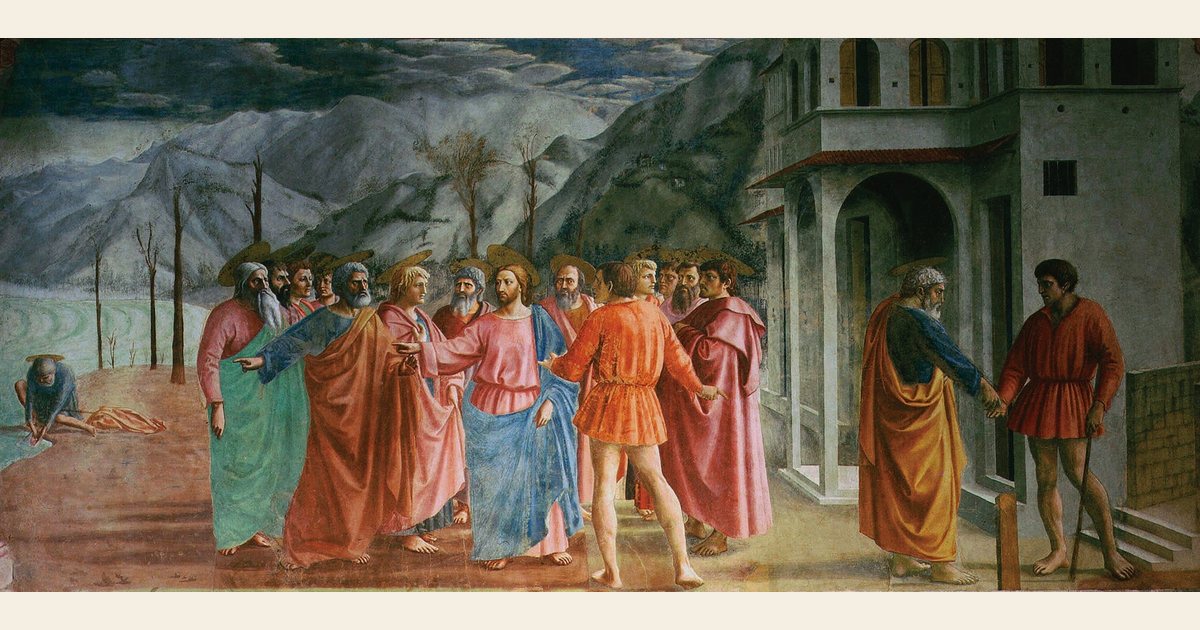
Above you on the left wall is the largest scene in the chapel, nearly six metres wide. It tells the story from Matthew's Gospel in which a tax collector asks for the tribute owed, Christ tells Peter to take a coin from the mouth of a fish, and Peter pays. Masaccio puts three moments in one landscape. In the centre, the collector, seen from behind in a short tunic, stops Christ and the apostles. On the left, Peter crouches by the lake to take the coin from the fish. On the right, at the city gate, he hands it over.
The apostles stand around Christ like a ring of columns, solid and still, under a sky over mountains that fade into the distance. Masaccio built the scene in single-point perspective, and the vanishing point is Christ's head. The fresco was painted in 32 working days; the joins between the day-sections of plaster can still be traced.
Some damage is permanent. Details added after the plaster dried, such as the leaves on the trees, have gone, and Christ's robe has lost much of its original blue. Our separate guide to the Tribute Money goes through it figure by figure.
The upper register: Masolino's Peter
Behind the altar, on the upper left of the window, is Masolino's St Peter Preaching. Peter speaks to a crowd with a raised hand; the faces around him range from rapt attention, like the veiled nun in the foreground, to drowsiness. Masolino painted it in eight working days.
On the upper right wall is Masolino's Healing of the Cripple and Raising of Tabitha, two miracles in one Florentine square. On the left Peter heals a cripple at the temple gate; on the right he raises Tabitha from her bed. Between the two, two young men in fashionable dress stroll across the square, paying no attention to either miracle. The townscape behind them is a careful perspective of houses and loggias.
Masolino is easy to underrate in this company. His figures are elegant rather than weighty, but his streets and buildings are among the first in Florentine painting built to a single vanishing point.
Masaccio behind the altar
To the right of the window, upper register, is Masaccio's Baptism of the Neophytes. Peter pours water over a young man kneeling in a stream in a narrow valley. Behind, another young man waits his turn, arms wrapped round his naked body against the cold. On this side of the window the light comes from the left, again from the window.
Below, on the lower register to the left of the altar, is St Peter Healing with his Shadow. Peter walks down a Florentine street, followed by John, without looking at the sick men he passes; as his shadow falls on them they are healed. One is already standing, one is rising, one still crouches on the ground. The figure in the red cap has been identified as a portrait of Masolino.
To the right of the altar, lower register, is the Distribution of Alms and Death of Ananias. Peter gives alms to the poor of the community, a mother holding a child among them, while Ananias, who held back part of his money, lies dead at his feet. Like the Tribute Money, it may reflect the debate about the Catasto, the new Florentine property tax of 1427.
The lower left wall: Theophilus and St Peter enthroned
Below the Tribute Money is the Raising of the Son of Theophilus and St Peter Enthroned. It is half Masaccio and half Filippino Lippi, and it marks the point where the work stopped in 1427. Masaccio painted the central part, with the enthroned Peter on the right in an architectural niche; Filippino completed the scene more than fifty years later, including the revived boy.
The crowd is full of portraits. The group at the far right is said to show Brunelleschi, Leon Battista Alberti, Masaccio and Masolino. Portraits of the Brancacci and their circle are thought to have been hammered off after the family's exile, which helps explain why Filippino had to fill gaps in a scene already begun.
Filippino Lippi's scenes
Filippino painted the lower register of the right wall and the lower parts of both pilasters. The big right-hand panel shows the Disputation with Simon Magus before Nero and the Crucifixion of St Peter, outside walls that can be recognised as Rome from the pyramid of Gaius Cestius. Filippino's self-portrait is in the right-hand group of the disputation.
On the lower pilasters are two prison scenes: St Paul visiting St Peter in prison, on the left, and the angel freeing Peter from prison, on the right, with a sleeping guard leaning on his staff. Look at how Filippino carries the architecture of the neighbouring scenes into his own, so that the walls read as one.
The altar and the Madonna del Popolo
On the altar stands a painted panel of the Madonna and Child known as the Madonna del Popolo. It probably dates from the thirteenth century, possibly from around 1268, when the church was founded, and it is older than any of the frescoes around it. It was placed in the chapel after 1436, when the Brancacci were exiled and the chapel was rededicated to the Virgin.
Its gold ground and flat, hieratic figures make a useful measuring stick. Look from the Madonna to Masaccio's St Peter Healing with his Shadow beside it and you see, in a single glance, how far painting travelled between the thirteenth century and the 1420s.
How to use your thirty minutes
A good order: two minutes in the centre to take in the whole room; then the Expulsion and the Temptation at the entrance, side by side; then the Tribute Money; then the altar wall, Baptism above and the Shadow and Alms scenes below; then across to Masolino's Tabitha; and finally Filippino's scenes and the Theophilus panel. Come back to the Tribute Money at the end if you have time. Most people do.
Bring nothing you need to manage. The space is small and your group fills it. If you want to read as you go, have this guide open on your phone, set to a low brightness.
Frequently asked
Which frescoes in the Brancacci Chapel are by Masaccio?
The Expulsion, the Tribute Money, the Baptism of the Neophytes, St Peter Healing with his Shadow, the Distribution of Alms and Death of Ananias, and the central part of the Raising of Theophilus' son.
Which scenes are by Masolino?
The Temptation of Adam and Eve, St Peter Preaching, and the Healing of the Cripple and Raising of Tabitha.
What did Filippino Lippi paint?
He completed the cycle in 1481–83: the Disputation with Simon Magus and Crucifixion of St Peter, both prison scenes on the lower pilasters, and the completion of the Theophilus scene.
Where is the Expulsion in the chapel?
On the left-hand pilaster at the entrance, upper register, beside the Tribute Money.
Why were the fig leaves removed?
They were added in 1642 and were not part of Masaccio's painting. The restoration completed in 1990 removed them.
Is there a Masaccio self-portrait?
Possibly. Some identify him among the apostles at the right of the Tribute Money; others in the group at the far right of the Theophilus scene.